


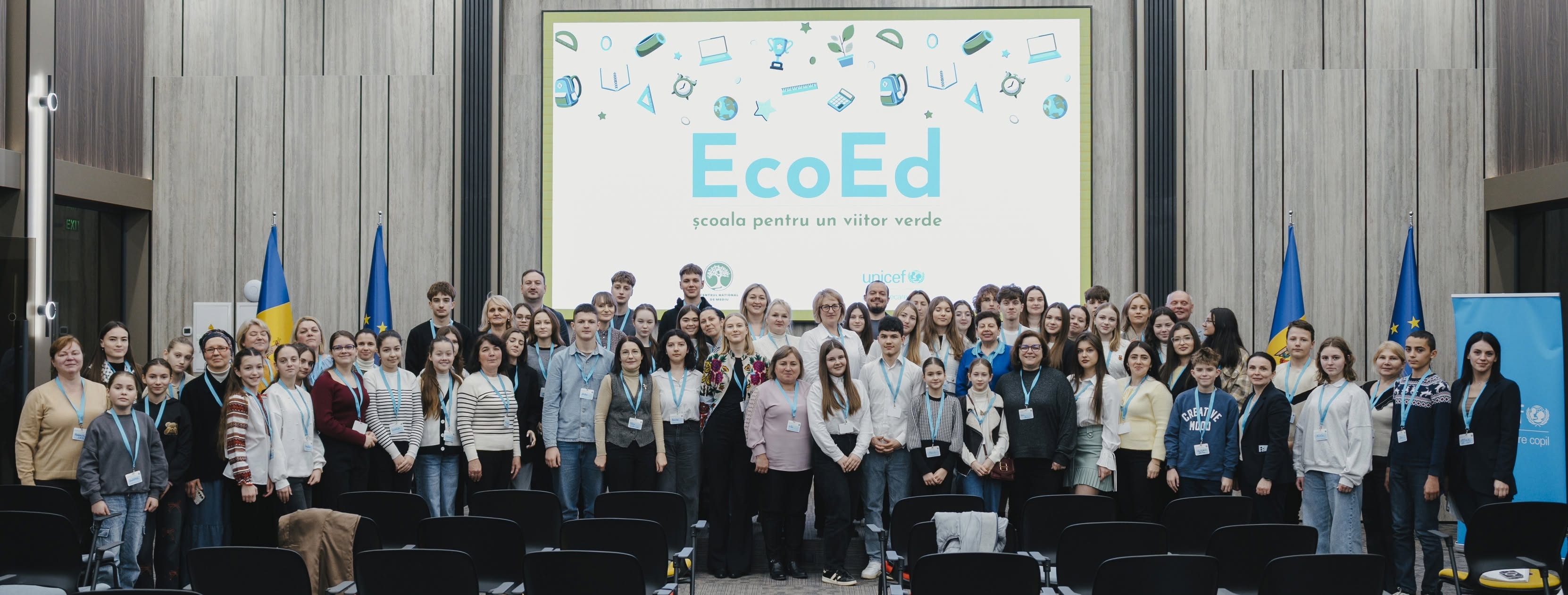
The UNICEF initiative EcoEd – School for a Green Future, implemented by the National Environmental Center, has shown that lasting change starts right in the classroom. Bringing massive benefits to both students and local communities, the program transformed young people from passive observers into active civic leaders—giving them the skills to spot local environmental issues and roll up their sleeves to fix them.
The project did far more than cut down school carbon footprints and boost energy efficiency; it equipped students with the "green skills" needed to become responsible, connected citizens.
The Project at a Glance:
-
29 schools successfully launched hands-on, student-led environmental mini-projects.
-
9 ultra-modern school eco-labs were set up from scratch.
-
1,000+ kids and youth jumped into eco-initiatives, debates, and civic campaigns.
From Idea to Action: Schools as Pillars of Local Sustainability
The appetite for green change blew past all initial expectations! Out of an impressive pool of over 150 registered schools nationwide, 30 were selected, and 29 brought their custom eco-projects across the finish line, tailoring solutions to their local needs.
Since every community faces distinct challenges, teams of students and teachers cooked up concrete solutions across six key areas:
-
Air Quality & Green Mobility: Installing smart sensors around schools to monitor pollution and building bike racks to encourage eco-friendly commuting.
-
Water Quality Monitoring: Creating school labs equipped with rapid-testing kits for local wells, springs, and rivers.
-
Soil Protection & Circular Economy: Building smart greenhouses, setting up composting stations, and bringing Bokashi composting directly into classrooms.
-
Energy Efficiency: Installing solar-powered charging stations and hosting energy-saving campaigns.
-
Responsible Waste Management: Setting up sorting points (for plastic, paper, and e-waste) alongside community awareness drives.
-
Greening Spaces & Community Action: Tree planting drives, local cleanups, and creating outdoor learning spaces.
"I realized we don't have to wait around for others to fix things. When I first saw the data collected by our sensors, or when we harvested our very own compost, I got it—every little action in our school makes a massive splash in the wider community."
— Participating Student
Success Stories Making Local History
A cornerstone of the project was setting up 9 permanent school eco-labs (three dedicated to water quality, three to air monitoring, and three to soil protection & circular economy). In these creative spaces, students run real physical-chemical tests on local water, track air pollution indicators, and test out Bokashi composting and smart greenhouses.
These practical projects created visible changes in both school budgets and student habits. Check out a few standout examples that are inspiring the whole country:
-
Free Clean Energy: One partner school set up a solar-powered charging station for mobile devices, which quickly became a huge hit during breaks.
-
The Waldorf Greenhouse & Bokashi Compost: At the "Waldorf" Theoretical High School in Chișinău, classroom food scraps are turned into nutrient-rich compost via the Bokashi method. Plus, inside their "Waldorf Greenhouse," students planted 400 oak seeds, tracking their growth firsthand.
-
An Outdoor Learning Oasis: Porumbrei Gymnasium (Cimișlia district) created an outdoor Eco-Classroom, taking geography and biology lessons straight out into nature.
-
Going Circular Locally: "Regele Mihai I" Gymnasium built a composting platform where yard trimmings and cafeteria scraps are transformed into natural fertilizer for the school grounds.
-
Energy Efficiency Meets Green Traditions: At "Pro Succes" Theoretical High School in Chișinău, the building got a demo thermal scan to spot heat loss. This was paired with a lovely tradition: the "Graduates' Alley," where every graduating class plants trees before saying goodbye.
Education for the Future: TikTok Storytelling, Debates, and Green Careers
The educational heart of EcoEd focused on empowering youth—sharpening their critical thinking, communication, and activism. Over 1,000 students got involved directly:
-
266 students graduated from 5 regional training sessions on advocacy and climate policy.
-
552 students tackled big topics in 10 monitored Peer Parliament debate sessions.
-
64 students & 14 teachers attended a national green career guidance seminar.
-
~90 students joined live demo lessons on energy scanning and air quality tracking.
-
64 students acted as delegates in the final decision-making simulation.
A major highlight was digital media training. Students learned how to use photo/video tools and TikTok to translate complex environmental topics into creative, viral, and persuasive content.
Through personal growth workshops and the Green Careers Compass, students also explored how sustainability is reshaping the job market, opening doors to the eco-professions of tomorrow.
"I learned that to be heard, it’s not enough to just be right—you have to know how to tell your story. Social media and debates became our tools to give local environmental issues a powerful voice."
— Student Workshop Participant
"The job market is shifting radically. The EcoEd generation already understands that tomorrow's careers—whether in renewable energy, energy auditing, or eco-design—require a fresh mindset focused on protecting our natural resources."
— Project Expert
The EcoEd Web Platform
To keep the momentum alive, boost visibility, and share ideas, the initiative launched the EcoEd web platform—an interactive digital hub for the entire project. It brings together educational resources, best-practice guides, an interactive map of school projects, and inspiring student stories. It functions as a virtual learning community where teachers and kids can collaborate, replicate success stories, and inspire other schools to make the green transition.
The Peak Moment: Youth Taking Charge in the Simulated EU Environment Council
The project hit its high point on June 5, 2026 (World Environment Day), when 64 students from across Moldova gathered for an ambitious exercise in democracy: Simulating the Council of the European Union: Youth Decide for the Environment.
Stepping into the shoes of ministers and diplomats from all 27 EU member states, the youth debated climate policies focused on children's rights to a healthy environment. After intense negotiations, they drafted and adopted an official policy recommendation document, handing it directly to national authorities.
"Today, we weren't just students playing a role—we felt the weight of decisions that can genuinely change lives. We proved that the voice of young people in Moldova is ready to count at the highest level!"
— Student Delegate
"Climate change isn't a problem for the distant future; it's a reality affecting the health and development of children today. Involving young people in decision-making isn't just an educational opportunity—it's a fundamental right. When we give kids a seat at the civic table and help them voice policy recommendations, we turn their ideas into real-world impact for all of society."
— Gerrit Maritz, Deputy Representative, UNICEF Moldova
Looking Ahead
The EcoEd project proved beyond doubt that investing in environmental education and youth isn't just an option—it’s the surest path to a sustainable, clean society. Armed with new knowledge and backed by the EcoEd online community, schools across Moldova continue to serve as real-world labs for the future, building a generation that is active, responsible, and ready to protect our planet.
The "EcoEd – School for a Green Future" initiative was carried out as part of the broader project "Building Ecological Skills and Climate Knowledge Among Youth," implemented by the National Environmental Center between July 15, 2025, and July 14, 2026. You can find more details and photos from the project on the official EcoEd website.